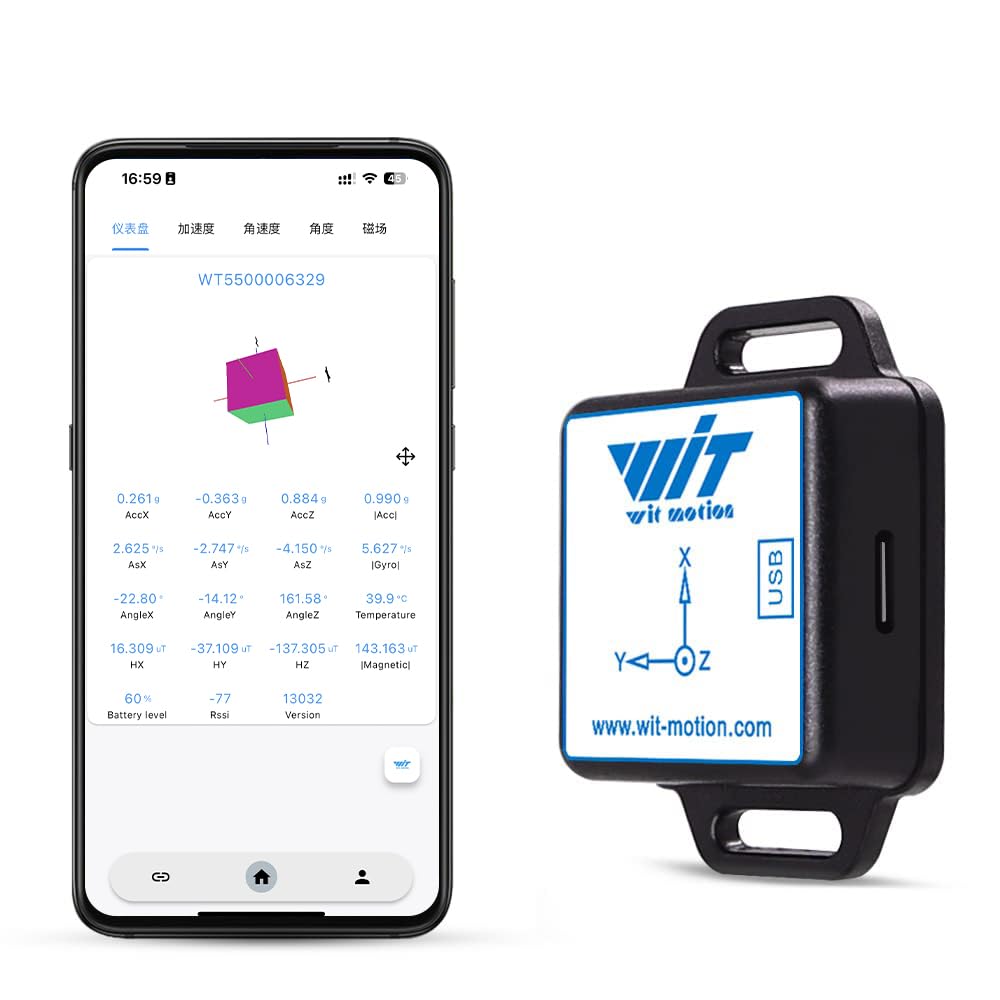
WITMOTION Brand Overview and History
WITMOTION has established itself as a trusted name in the world of motion sensing technology since its founding in 2012. Originating from Shenzhen, China—a global hub for electronics innovation—the company quickly rose to prominence by focusing on high-precision sensors for industrial and scientific use. WITMOTION's commitment to quality is evident in their adoption of cutting-edge components like the MPU9250 9-axis chipset, combined with proprietary Kalman filtering algorithms for superior data stability and accuracy.
Over the years, WITMOTION has expanded its portfolio to include Arduino-compatible modules, Bluetooth and WiFi-enabled devices, and rugged industrial-grade sensors. Their products have been deployed in diverse applications, from automotive tilt monitoring and drone stabilization to construction site inclinometers and medical equipment. With a strong emphasis on R&D, WITMOTION continually refines features like low-power consumption, high sampling rates up to 200Hz, and environmental resilience (IP67 waterproofing). Today, as an affiliate-favorite brand, WITMOTION boasts average ratings of 4.0+ across nine key products, making it a go-to for engineers, hobbyists, and professionals seeking reliable acceleration sensors.
Key Product Categories and Features
WITMOTION's lineup falls under Industrial Electrical > Sensors > Acceleration Sensors, offering versatile categories tailored for various needs. Here's a breakdown of their standout products and shared features:
- Industrial-Grade Accelerometers & Inclinometers: Models like HWT905-TTL (4.4/5) and HWT901B-TTL feature XY angle accuracy of 0.05°, digital compass, air pressure/altitude sensing, RM3100 magnetometer compensation, and Kalman filtering. IP67 waterproof for harsh environments.
- Arduino-Compatible IMU Sensors: WT901 (4.1/5) and BWT901CL (3.8/5) provide 3-axis acceleration, gyroscope, tilt angle, and magnetometer data via USB at 200Hz. Ideal for Raspberry Pi and AHRS applications with high-stability outputs.
- Bluetooth & BLE 5.0 Modules: WT901BLECL (4.0/5), WT901BLECL+ (4.0/5), WT9011DCL (3.7/5), and WT901BLECL (3.7/5) offer low-power wireless connectivity, 0.05°-0.2° accuracy, and remote reading for Arduino projects.
- Data Loggers & Wireless Sensors: WT901SDCL-BT50 (4.0/5) includes a 16G SD card for offline 9-axis logging via Bluetooth 5.0. WT901WIFI (4.0/5) enables PC/Android compatibility for real-time tilt and motion monitoring.
Common features across categories include 9-axis fusion (accelerometer + gyroscope + magnetometer), temperature compensation, compact design, and easy integration with Kalman filtering to minimize noise and drift.
Why Choose WITMOTION Sensors?
Opting for WITMOTION means investing in battle-tested precision that outperforms generic sensors. Their 0.05° angle accuracy rivals premium competitors, while features like IP67 rating and wireless options (Bluetooth 5.0, WiFi) ensure versatility in industrial settings, robotics, and IoT. High user ratings—led by the HWT905-TTL at 4.4/5—reflect real-world reliability in vibration-heavy environments. Affordable pricing, plug-and-play Arduino support, and robust Kalman algorithms deliver drift-free data at 200Hz, saving time on calibration. Plus, with magnetometer and temperature compensation, these sensors maintain performance across -40°C to 85°C. For affiliate shoppers, WITMOTION offers excellent value, backed by detailed datasheets and community forums.
In summary, WITMOTION bridges hobbyist accessibility with industrial-grade toughness, making it ideal for applications like platform stabilization, seismic monitoring, and UAV navigation.
FAQ
What is the MPU9250 chip used in WITMOTION sensors?
The MPU9250 is a 9-axis IMU combining a 3-axis accelerometer, gyroscope, and magnetometer. WITMOTION enhances it with Kalman filtering for precise angle (XY 0.05°) and orientation data.
Are WITMOTION sensors suitable for outdoor or industrial use?
Yes, models like HWT905-TTL are IP67 waterproof and feature temperature/magnetometer compensation, ideal for harsh environments in construction, vehicles, and drones.
How do Bluetooth models compare to wired ones?
Bluetooth 5.0 versions (e.g., WT901BLECL) offer low-power wireless remote access up to 50m, while wired TTL/USB models provide higher stability for stationary industrial setups.
Can these sensors work with Arduino or Raspberry Pi?
Absolutely—WT901 and similar modules include Arduino libraries and USB interfaces for seamless integration with Raspberry Pi AHRS projects.
What makes Kalman filtering important in these sensors?
Kalman filtering fuses sensor data to reduce noise, drift, and errors, ensuring high-accuracy tilt angles and stable outputs even in dynamic conditions.